
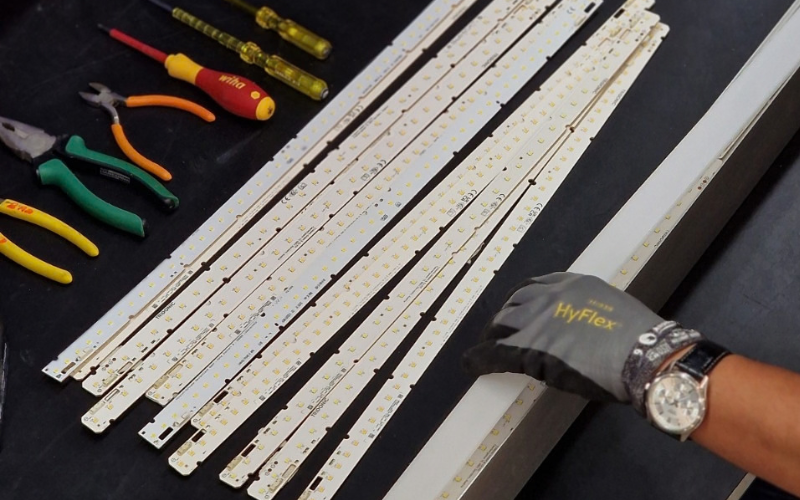
Custom linear lighting works best when the ceiling detail, light output and electrical system are designed together. A slim illuminated line may look simple in a rendering, but the finished result depends on the profile depth, diffuser, LED module, driver location and access for maintenance.
For contractors, designers and property owners comparing custom linear lighting in Qatar, this guide explains what to specify before ordering a recessed, surface-mounted or suspended assembly. Evolum’s bespoke lighting workshop in Doha builds solutions around project dimensions and compatible components.
Start with the purpose of the light
Decide whether the linear run provides general illumination, lighting over a work surface, a decorative ceiling feature or indirect light. These uses need different outputs and optical arrangements. A ceiling perimeter that creates atmosphere should not automatically be counted as the main light source for a desk or counter.
Describe the room dimensions, mounting height, finishes and activities. Where the run must deliver working illumination, request a lighting calculation using the proposed assembly’s photometric data. Wattage alone does not describe how much useful light reaches the surface.
Choose the mounting detail before the profile
| Mounting type | Useful application | Detail to resolve |
|---|---|---|
| Recessed | A line integrated into a ceiling or joinery | Cut-out, flange, ceiling thickness and service access |
| Surface-mounted | Exposed ceilings or limited ceiling voids | Fixing positions, cable entry and visible finish |
| Suspended | Desks, counters and architectural features | Suspension points, drop length and cable management |
| Indirect or cove | Soft illumination reflected from a wall or ceiling | Setback, concealment and the reflective surface |
Confirm these details with the ceiling or joinery contractor. A profile that fits the drawing may still clash with a duct, sprinkler route or structural fixing. A coordinated section drawing is more useful than a product photograph.
Specify a continuous appearance
Visible LED dots usually come from the combination of emitter spacing, distance to the diffuser and diffuser properties. A deeper profile or closer LED spacing can help, but there is no universal depth that guarantees a seamless line. Test the complete profile, module and cover combination at the intended viewing angle.
For connected runs, ask how corners, joints and end sections will be assembled. Mechanical joints can create visible seams even when the light source is continuous. Long runs also need a planned electrical feed arrangement so brightness does not fade toward one end.
Compare light quality, not just watts per metre
Ask for the assembled luminaire’s output where available. A diffuser changes the light leaving the fixture, so the bare strip’s lumen figure is not necessarily the finished assembly’s output. Specify a colour temperature that suits the room and evaluate it against the actual ceiling, flooring and joinery samples.
Colour rendering is a separate consideration. The US Department of Energy’s LED Basics guide explains that CCT describes colour appearance, while colour fidelity describes how objects look under the source. Request consistent colour bins for adjacent sections and keep the approved sample as a reference.
Match the LED module, driver and control system
Confirm whether the selected light engine needs constant voltage or constant current. A compatible driver must match the electrical requirements and the intended control input. A driver chosen only because its wattage seems large enough can still be unsuitable.
State the required control method before procurement: simple switching, compatible phase dimming, an analogue control input or DALI. For a DALI project, specify compatible system components and a commissioning plan; the DALI Alliance’s key features guide describes individual and group addressing and scene control.
Locate drivers where technicians can reach them without cutting finished ceilings. Check ventilation, operating conditions and cable routes. A neat lighting feature should remain serviceable after handover.
What to send for a quotation
- Dimensioned plans and sections, including each run and corner.
- Quantity, mounting type, suspension requirements and finish.
- Application, mounting height and target lighting performance.
- Preferred colour temperature and colour-rendering requirements.
- Control protocol and the existing control system, if any.
- Driver locations, access arrangements and environmental exposure.
- Delivery sequence and any sample or mock-up requirement.
A clear schedule makes proposals easier to compare. Ask each supplier to identify the profile, LED module, diffuser, driver and included assembly work rather than providing only a price per metre.
Frequently asked questions
Can a linear light be made to an exact length?
The housing can often be fabricated to project dimensions, but the light engine’s cutting increments and end details affect the illuminated length. Confirm both the overall dimension and the visible lit length in the approved drawing.
Does a higher-wattage strip always give a better result?
No. Output, optical losses, heat management and the intended use all matter. More power can create unwanted brightness or higher temperatures without improving the lighting layout.
Can the driver be hidden above a ceiling?
Only where the installation provides suitable conditions and future access. Agree an access panel or another practical servicing route before the ceiling is closed.
Discuss a custom assembly with Evolum
Explore Evolum’s lighting components or custom lighting solutions. To start a project enquiry, send your drawings, dimensions and control requirements. Evolum can assess the practical assembly route and recommend a compatible specification.