
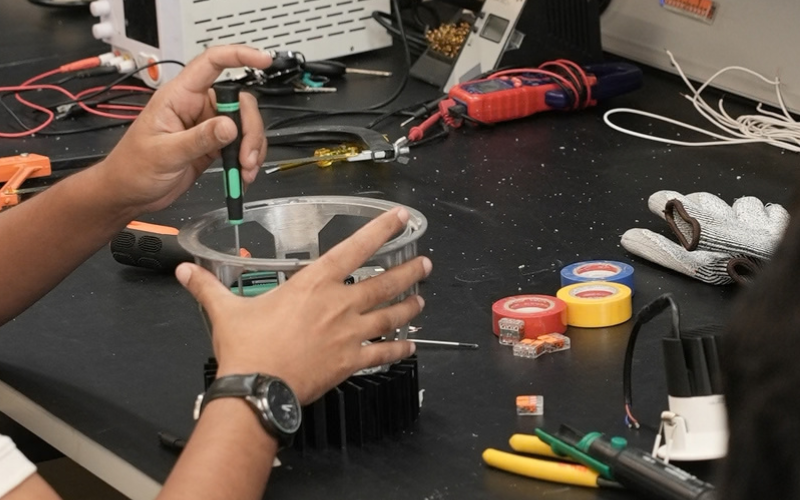
Outdoor lighting in Qatar should be selected around the installation environment, not simply a product labelled “waterproof”. A fitting for a sheltered entrance faces different conditions from a ground-level landscape light, an exposed façade or a coastal location.
Before ordering, compare the complete luminaire’s enclosure, thermal limits, finish, optics and servicing arrangement. These checks help contractors and facility managers choose a system that can perform in its intended position and remain maintainable.
Describe the actual exposure
Record whether each fitting will face direct sunlight, irrigation, windblown dust, cleaning water, coastal exposure or possible standing water. Include mounting orientation and the location of junction boxes and drivers. The luminaire’s rating cannot compensate for unsuitable connections elsewhere in the system.
A practical site schedule should distinguish sheltered wall fittings, landscape luminaires, façade fixtures and ground-recessed products. Do not apply one generic specification to every location without reviewing those differences.
Read the IP rating in context
The IP code classifies enclosure protection against ingress. The IEC 60529 standard overview identifies the standard behind this classification. Check the declared rating for the assembled fixture, its connectors and the required mounting arrangement.
A rating for immersion and a rating for water jets describe different test conditions. If a location faces both, confirm the appropriate declared protection rather than assuming a higher-looking number covers every exposure. Follow the product’s installation instructions, including cable glands, seals and orientation.
Ingress protection does not establish resistance to heat, corrosion, ultraviolet exposure or impact. Those characteristics need separate product information. An “outdoor” label without a datasheet is not enough for a project specification.
Check temperature limits and driver conditions
Ask for the luminaire’s permitted ambient-temperature range and any limits on the stated performance. A driver installed in a small closed box may experience different conditions from the surrounding air. Check the temperature at the intended equipment location and the manufacturer’s derating requirements.
For example, Signify’s TownTune product data lists ingress protection and ambient-temperature information separately. It also notes protective dimming at extreme temperatures. This illustrates why an IP rating alone cannot establish thermal suitability; verify the exact model proposed for your project.
Review finishes and corrosion exposure
For coastal or chemically exposed locations, ask for documented suitability of the housing, coating, fasteners and mounting accessories. Salt, cleaning chemicals and contact between different metals can create conditions that a general-purpose finish was not selected to withstand.
Include the exact installation location in the supplier enquiry and review any environmental limitations in the warranty. Do not describe a product as marine-grade without supporting documentation for the actual assembly and exposure.
Choose optics for the task
A pathway needs light directed onto the walking surface. A façade feature needs a distribution suited to the height and setback. A landscape accent should reveal the selected feature without sending unnecessary light toward windows or the sky.
Request photometric data and a layout review rather than selecting only by wattage. Inspect the result from pedestrian viewpoints and neighbouring areas. Shielding, aiming and control schedules are often more useful than simply choosing a brighter fitting.
Plan for cleaning and component replacement
Document how technicians will reach the luminaire, isolate it and replace serviceable components. Ground-mounted fittings may need a drainage detail; elevated fixtures may need access equipment. Include these practical requirements in the maintenance plan.
Keep seals, cable entries and covers in the inspection routine. After a repair, reassembly must preserve the intended protection. A replacement driver that fits electrically may still be unsuitable for the enclosure’s temperature or environmental conditions.
Where existing housings remain sound, Evolum’s luminaire assessment and repair service can review the practical repair route. For the wider decision, read when to repair or replace LED luminaires.
An outdoor-lighting procurement checklist
- Exact location, exposure and mounting orientation.
- Required ingress and impact protection for that position.
- Ambient-temperature limits and driver derating information.
- Housing, coating and fastener suitability for the environment.
- Photometric files, proposed aiming and glare review.
- Connection, drainage and accessible equipment details.
- Control method, operating schedule and spare-component information.
Frequently asked questions
Is IP65 enough for every outdoor light?
No single rating suits every exposure. Review the intended location, cleaning method, water exposure and installation instructions. Ground-recessed or immersion applications need specific consideration.
Can a sealed outdoor fitting still overheat?
Yes. Sealing concerns ingress; temperature suitability depends on the complete design and operating environment. Check the luminaire and driver specifications separately.
Should a water-damaged fitting be repaired?
Assess the ingress route, internal damage and ability to restore the assembly’s protection. Replacing one failed component without resolving the enclosure problem can lead to another failure.
Request a site-specific assessment
Send Evolum photos, model labels and the installation locations. Include quantities, operating hours and any recurring failures so the workshop can assess a suitable repair, retrofit or component recommendation for your Qatar project.